
Dice Attack : Roguelike Battle
Fun Games TeknolojiStrategy
4.0155.00 Reviews
- Version
- 1.6.1
- Installs
- 100.00K
- Age Rating
- Everyone
Screenshots

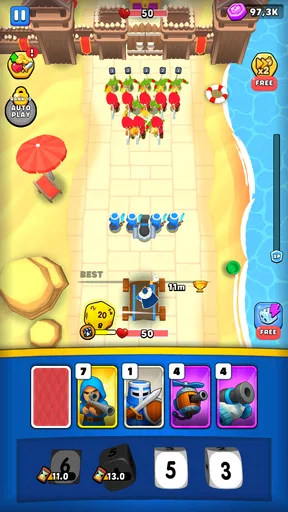
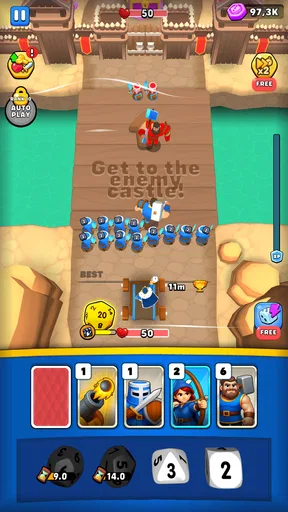
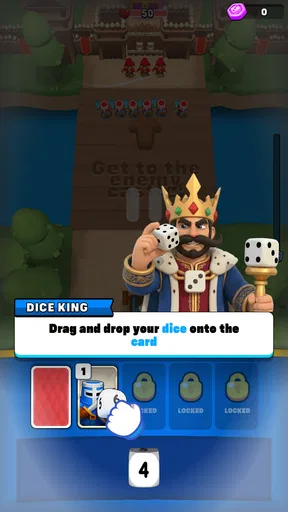
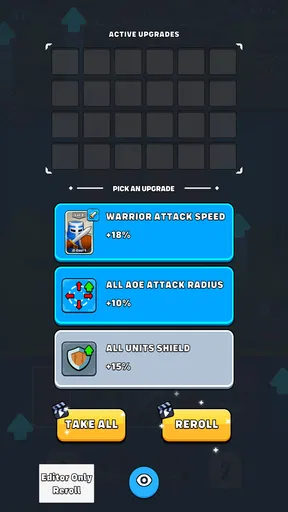

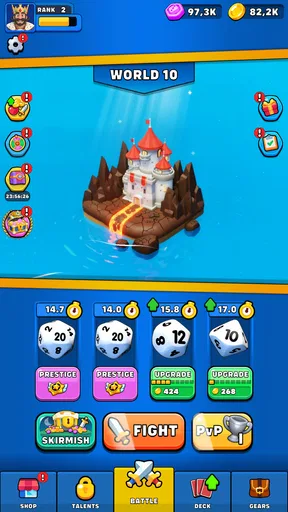

Our Review of Dice Attack : Roguelike Battle
 Analysis by Appyee
Dice Attack: Roguelike Battle is a free strategy game from Fun Games Teknoloji that turns the familiar act of rolling dice into a series of tactical choices. I found its appeal less in the roll itself and more in what follows: deciding how much to trust a favorable result, when to protect a strong position, and when to accept risk because a safer move will not be enough. It is aimed at players who enjoy short strategic decisions with a little randomness in the mix, rather than people looking for a long, story-heavy adventure.
The game is available for Everyone and runs on operating systems version 11 or later. It has reached over one hundred thousand installs, with an average rating of 4.0 from around 2.8 thousand ratings. Those figures suggest a healthy audience without pretending that every player will enjoy the same style of play. My own impression is that this is best approached as a compact strategy game for spare moments: easy to start, but more interesting once you stop treating every roll as an isolated event.
How the dice shape your decisions
The central idea is straightforward: you roll, use the result to strengthen your army or attack, and try to turn a small advantage into a winning position. That simplicity is useful because the game does not bury its main decision under complicated menus. At the same time, it creates an important distinction between luck and judgment. You cannot control every outcome, but you can control how exposed you are when the outcome is poor.
I quickly found that the most tempting move is not always the best one. A powerful result can encourage an immediate attack, yet spending everything at once may leave you with no flexibility for the next exchange. A modest roll can be more valuable when it helps preserve a stable position or prepares a stronger follow-up. The game works best when I think one or two turns ahead instead of asking only, “What can I do with this roll right now?”
That planning horizon gives the battles their character. The random element keeps the game from becoming a fixed puzzle, while the army-building decisions give the result some direction. If you prefer strategy games where every outcome can be calculated exactly, the dice may feel frustrating. I would point those players toward a more deterministic tactics game. Here, the satisfaction comes from making a sensible plan with incomplete control and then adjusting it when the roll refuses to cooperate.
One useful habit is to separate a good roll from a good opportunity. A high-value result is only truly useful if the board situation lets you convert it into something lasting. Before committing, I consider whether the move improves my position after the immediate attack, whether it leaves a vulnerable gap, and whether I am spending resources that might be more valuable after the next roll. That small pause prevents the game from becoming a string of impulsive clicks.
Building an attack without overcommitting
The strongest decisions often involve choosing how much force to place behind an attack. A full commitment can end a problem quickly, but it also reduces room to respond if the result is weaker than expected. A partial commitment may appear less exciting, yet it can preserve options and make the next turn easier to manage. This is especially important when the opposing position is not clearly weak enough to justify an all-in move.
I also prefer to treat defensive strength as an active resource rather than wasted power. Holding something back can make a later roll meaningful, because I still have enough flexibility to respond. That is a trade-off many casual players may overlook at first. The game rewards aggression, but not aggression without timing. The right question is not simply whether I can attack; it is whether attacking now improves my chances more than waiting with a usable reserve.
A practical everyday scenario shows where the game fits. If I have a few minutes while waiting for an appointment, I can start a session without needing to remember a complicated story or rebuild a large strategy from scratch. I can focus on the current position, make a handful of decisions, and stop when the session is over. That convenience is a real strength, although players who want a deep campaign with extensive long-term world building may find the format too focused on repeated tactical moments.
Risk feels meaningful when the reward changes the next turn
Randomness is most enjoyable when it creates a decision rather than simply deciding the result for me. In Dice Attack, the interesting risk is committing to an uncertain line because the possible payoff would change the shape of the battle. If success only produces a small improvement, caution usually makes more sense. If success can open a route to a much stronger position, accepting danger becomes easier to justify.
I try to judge risk through recovery. Before making a bold move, I ask whether a bad outcome leaves me able to rebuild, or whether it turns one unlucky roll into a losing spiral. This is a more useful approach than chasing the largest possible reward every time. A risky play is not automatically clever just because it could work. It becomes clever when the downside is survivable and the upside addresses a real problem.
That principle also helps with the game’s free-to-play structure. The game costs nothing to download and includes in-app purchases ranging from $0.99 to $99.99 per item. I would advise treating purchases as optional convenience rather than part of the basic strategy. If you are the kind of player who feels pressured to spend whenever a run goes badly, set a personal limit before playing. The dice already introduce uncertainty, so adding unplanned spending can make a frustrating session feel worse.
For players who enjoy free games but dislike any possibility of purchases, this is worth considering before installing. For everyone else, the important question is whether the core decision-making is enjoyable without buying anything. In my view, the game is most satisfying when I judge the position I have rather than trying to purchase a better one. That keeps the challenge focused on planning, timing, and adaptation.
Adapting after an unlucky roll
The game’s roguelike identity makes adaptation especially important. I do not approach every attempt with a single rigid plan, because a poor roll can change which option is realistic. When that happens, the best response is usually to reduce the scale of the goal. Instead of forcing an immediate victory, I look for a move that preserves strength, limits damage, or creates a better setup for the next chance.
This is where the game can teach a useful strategy lesson: a failed plan does not always mean a failed run. Sometimes the mistake is continuing to pursue the original plan after the situation has changed. If an early attack no longer looks favorable, I would rather stabilize than spend more resources trying to prove that the first idea was correct. That flexibility matters more than memorizing one supposedly perfect sequence.
I also recommend noticing patterns in your own decisions. When a session goes badly, it is easy to blame the dice, but reviewing the moment before the loss can reveal a preventable error. Did I attack because the opportunity was genuinely strong, or because I was impatient? Did I leave enough strength to respond? Did I mistake a temporary advantage for a guaranteed win? Those questions make the next attempt more useful, even when the outcome was unlucky.
Another practical tip is to avoid changing every decision at once. If a strategy fails, adjust one habit, such as keeping a reserve or waiting for a clearer attack, and see whether that improves your results. This makes it easier to understand what actually helped. Random games can hide the effect of good decisions over a short session, so gradual adjustment is more reliable than swinging from reckless aggression to excessive caution.
Where the depth comes from over time
At first, the game’s appeal comes from immediate feedback: roll, decide, attack, and see what happens. After more time, the depth comes from recognizing recurring trade-offs. You begin to notice that the same result can have different value depending on your current strength, the opponent’s position, and how much flexibility you have left. That is the point where the game moves beyond a simple dice gimmick.
Its depth is not the same as that of a traditional board-game adaptation or a large strategy title. I would not choose it for detailed diplomacy, expansive maps, or a long list of interconnected systems. Instead, it offers a narrower form of mastery. You are learning when to press, when to wait, and how to make a reasonable choice when certainty is unavailable. Players who enjoy refining judgment in repeated short sessions will get more from it than players who need constant new content to stay interested.
The version I reviewed is 1.6.1, and the game has been available since June 4, 2024. I mention that because the experience feels like something to evaluate on its present strengths rather than as a promise of a giant strategy platform. Its identity is clear: dice-driven battles, army decisions, and roguelike uncertainty. That focus is positive when you want a compact game, but it also means the experience may feel repetitive if the basic roll-and-respond loop does not hold your attention.
Compared with ordinary dice games, this offers more agency because the roll is only the beginning of the decision. Compared with conventional turn-based strategy games, it gives you less control over exact outcomes and asks you to manage uncertainty instead. Compared with idle or auto-battle alternatives, it is more engaging when you want to make choices yourself, though it may be less relaxing if you prefer a game that largely plays in the background.
That comparison also clarifies who should skip it. I would not recommend it to someone who dislikes luck in competitive decisions, wants a substantial narrative, or expects every battle to offer a completely different ruleset. I would also be cautious about recommending it to players who tend to make purchases impulsively in free games. On the other hand, it suits someone who likes quick tactical problems, enjoys replaying a run to improve a decision, and can accept that a good plan may still need help from the dice.
Small habits that make each session better
My first recommendation is to identify the purpose of the current turn before rolling into action. Am I trying to deal immediate damage, protect a lead, recover from a weak position, or prepare for a stronger opportunity? Naming that purpose keeps the result from dictating my entire plan. It also makes a mediocre roll easier to use because I can judge it against a goal instead of against an ideal outcome.
Second, I avoid spending every advantage immediately. Even when a move looks strong, I consider what happens if the next result is poor. Keeping some flexibility is particularly valuable when the current attack is not decisive. This does not mean playing passively; it means making sure aggression leaves me with a second plan.
Third, I use losses as information about timing rather than proof that the game is unfair. If I repeatedly lose after early attacks, I delay the next attack and watch whether the position improves. If I lose by waiting too long, I become more willing to accept manageable risk. This kind of self-correction is where the game’s strategic value appears, because the same dice can expose different weaknesses in different players.
Finally, I would play in short focused sessions rather than forcing a long marathon. The decision quality drops when I start clicking automatically, and this type of game depends on noticing the difference between a tempting move and a genuinely useful one. A brief break can be more valuable than another attempt made without attention.
My strategy verdict
Dice Attack: Roguelike Battle is a focused strategy game that uses dice to create uncertainty without removing the player’s responsibility. I like it most when I treat each roll as a prompt for planning rather than as a lottery result. The best moments come from turning a modest opportunity into a stable advantage, or recovering from a bad outcome without abandoning the whole run.
Fun Games Teknoloji has kept the concept approachable, which helps the game work for casual players and for strategy fans who want something lighter than a full-scale tactics title. The Everyone rating and free entry also make it easy to try. Still, the free-to-play purchase range, repeated core loop, and reliance on luck mean it will not be right for everyone. Players should decide in advance how they feel about optional spending and whether repeated dice-based battles sound enjoyable over time.
My recommendation is strongest for people who enjoy short sessions, risk management, and adapting plans under pressure. I would choose a more deterministic strategy game when I want precise control, a deeper campaign, or a richer narrative. But when I want a quick battle that still asks me to think beyond the immediate move, this is a worthwhile download. The key is to play the position, not just the roll.
Verdict
Strengths of Dice Attack : Roguelike Battle
- Quick battles make it easy to play during short breaks.
- Randomized runs keep each attempt feeling different.
- Dice mechanics add a satisfying element of luck and strategy.
- Runs offer clear progression through upgrades and new abilities.
- Bright visuals and simple controls are accessible for most players.
Limitations of Dice Attack : Roguelike Battle
- Luck can sometimes outweigh careful planning during difficult encounters.
- Repeated runs may feel similar after the main mechanics become familiar.
- Some upgrades are less useful unless paired with specific dice effects.
- Difficulty spikes can make later stages feel noticeably less forgiving.
- Players who dislike turn-based combat may find the pace too slow.
Other Releases by Fun Games Teknoloji
View All
Gun up Weapon Ball Shooter
Role Playing4.2
Similar Picks in This Category
View All
Clash of Clans
Supercell4.5

Plants vs. Zombies™
ELECTRONIC ARTS3.7

Lords Mobile: Kingdom Wars
IGG.COM4.5

Clash Royale
Supercell4.4

State.io — Conquer the World
CASUAL AZUR GAMES4.1

Car Driving School : Car Games
Spark Game Studios3.9
Frequently Asked Questions
What is Dice Attack: Roguelike Battle?
Dice Attack: Roguelike Battle is a turn-based strategy game that combines dice-based combat with roguelike progression. You build a team or collection of dice, choose attacks and abilities during battles, and make decisions that affect each run. Encounters are designed to change from one attempt to another, so adapting your strategy is usually more important than simply repeating the same actions.
How does combat work in Dice Attack: Roguelike Battle?
Combat revolves around rolling or managing dice to determine attacks, effects, and available actions. Each turn requires you to consider possible damage, defensive options, and the abilities you want to save for later. Because outcomes include an element of chance, successful play depends on combining favorable rolls with smart timing, upgrades, and careful resource management rather than relying only on luck.
Is Dice Attack: Roguelike Battle suitable for beginners?
The game is relatively approachable for players who enjoy casual strategy, but it may take a few runs to understand its systems. New players need to learn how dice abilities interact, which upgrades are worth choosing, and when to take risks. Early defeats are part of the experience, as each attempt helps you recognize enemy patterns and improve future decisions.
Does Dice Attack: Roguelike Battle require an internet connection?
Whether a connection is required can depend on the version, device, and specific features being used. Core roguelike battles may be playable offline, but advertisements, cloud saves, updates, leaderboards, or other online services can require internet access. Before downloading, check the current store description and test the game in offline mode if uninterrupted play is important to you.
Is Dice Attack: Roguelike Battle free to download, and does it include purchases?
Dice Attack: Roguelike Battle may be available as a free download, but free access does not always mean that every feature is completely unrestricted. Games in this genre can include advertising, optional in-app purchases, bonus resources, or progression-related offers. Review the Google Play or App Store listing for the latest pricing details, then check the device’s purchase settings if children will be playing.
Play our best games!


